In Four Hands, Two Sonatas, the two leads share one piano for Saint-Saëns’s Danse Macabre. Search for the sheet music, though, and you will find solo arrangements, four-hand duets, two-piano scores and “easy” versions at every level, so it is hard to tell which one to get.
See Danse Macabre sheet music on mymusic5
Should you choose solo or four hands?
If you’ll be practicing alone, get a piano solo. If you have a partner and want to share one piano like the leads in the drama, get a four-hand duet (one piano, two players). On mymusic5, the Instrumentation field in the product details shows Solo, Four Hands or Two Pianos, so check it before you buy.
| Piano solo | Four hands (one piano) | Two pianos (four hands) | |
| You need | 1 piano, 1 player | 1 piano, 2 players | 2 pianos, 2 players |
| Score layout | Usually a grand staff (2 staves) | Both parts in one score (usually 4 staves) or separate parts | A part for each piano |
| Good for | Practicing alone, recording a cover | Teacher and student, duets with a friend | Recitals or studios with two pianos |
| Watch out for | One player covers melody and accompaniment, so it can get busy | Playing in time with your partner takes extra practice | Easy to confuse with one-piano duets |
Playing it as a duet: primo and secondo
In a one-piano duet, the player on the upper half of the keyboard is the primo and the player on the lower half is the secondo. Ernest Guiraud’s four-hand arrangement, published by Durand in Saint-Saëns’s lifetime, already labels its parts “Seconda” and “Prima.” The secondo holds down the bass and the rhythm while the primo leads the melody, and in Danse Macabre the two roles are especially clear.

Let’s look at freestyle pianoman’s four-hands score from the table. In bars 1–12 the secondo strikes D twelve times for midnight while the primo only adds long held chords above. After a bass introduction, the primo hammers out Death’s violin chord, the tritone A–E♭, in bar 25, and from bar 33 the primo’s right hand takes the waltz theme while the secondo plays the oom-pah-pah accompaniment. When you first play it together, lock in just two moments, the secondo’s twelve D’s and the first chord in bar 25, and the whole piece will sound far steadier.
Danse Macabre sheet music by level
We picked one sheet for each format and level and opened every score ourselves; the notes in the last column come from those scores. Levels are the ones each seller set in the store.
| Format | Sheet | Store level | Pages | What we checked in the score |
| Solo | THIS IS PIANO “Easy version” | Beginner | 2 | Original G minor, shortened to 61 bars |
| Solo | Easy Piano “very easy, short” | Beginner | 3 | Transposed to A minor (no key signature), both hands in treble clef |
| Four hands (one piano) | Easy Piano “very easy duet” | Beginner | 4 | An easy duet transposed to A minor (no key signature) |
| Solo | THIS IS PIANO “Intermediate version” | Easy | 4 | Original G minor, longer than the Easy version |
| Solo | Sora Hong “Solo Piano Ver.” | Normal | 6 | G minor, opens with a left-hand bass introduction |
| Four hands (one piano) | freestyle pianoman four-hands version | Normal | 28 | The secondo opens with the twelve D’s that strike midnight |
| Four hands (one piano) | Bella & Lucas “Danse macabre (4 Hands)” | Hard | 13 | Written for one piano, includes a 7-page short version |
| Two pianos | KLAVlER “2 Piano, 4 Hands” | Hard | 24 | Piano I and II each have a full two-hand part |
| Solo | KLAVlER “Solo Piano” | Expert | 17 | G minor, original tempo marking “Mouvement modéré de Valse” |
| Solo | Liszt arrangement (S.555) | Expert | 46 | Engraving of Liszt’s solo transcription, includes an MP3 of the original |
| Violin | NUA Violin “Easy Violin” | Easy | 9 | Violin part with piano accompaniment, includes an accompaniment MP3 |
We could not find an official score of the exact arrangement played in the drama. Sheets introduced as a “drama version” or “episode 2 version” are the sellers’ own arrangements, so listen to their performance videos and check the previews before you choose.
The solo instrument in the original is the violin, so there are violin parts and piano trio arrangements too.
What to check when choosing an easy version
Easy versions differ in how much of the original they keep and whether they change key. THIS IS PIANO’s Easy version, for example, skips the twelve strokes and the bass introduction and opens straight on the violin’s tritone chords in bar 1. The waltz theme arrives in bar 9, a second melody of long notes stepping down G–F–E–E♭ begins in bar 26, and the piece ends in bar 61. Both Easy Piano sheets in the table move the original G minor to A minor with no key signature. Check these points before you buy:
- Instrumentation: check whether the product details say Solo, Four Hands or Two Pianos.
- Level: check the level in the product details.
- Length: page count and labels such as “short version” or “excerpt” tell you whether it is the full piece.
- Preview: on the first page, check the key signature, range and whether the chords fit your hands.
- Performance video: if there is one, listen for the tempo and mood you want.
A waltz in the graveyard at midnight
Danse Macabre, Op. 40, is a symphonic poem in G minor that Camille Saint-Saëns composed in 1874; it was published in 1875 and lasts about seven to eight minutes. It began in 1872 as a song for voice and piano on a poem by Henri Cazalis; when Saint-Saëns expanded it for orchestra, he gave the vocal line to a solo violin.
The music tells of Death playing the fiddle at midnight while skeletons dance, until the rooster crows at dawn and they return to their graves. The harp strikes the same note twelve times to mark midnight, and the solo violin tunes its top E string down a half step (scordatura) to sound a tritone. The xylophone imitates rattling bones, and the chant melody Dies irae is quoted in the middle.

The whole piece moves in the triple meter of a minor-key waltz. If reading 3/4 still feels new, start with guide to note lengths, rests and time signatures.
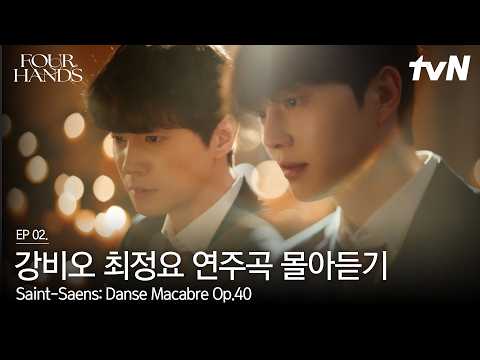
In Four Hands, Two Sonatas, it is the piece the two leads play together on one piano: Choi Jeong-yo, who struggles with stage fright, sits down at the piano again while rehearsing it with Kang Pi-o.
Piano versions from Saint-Saëns’s time
Danse Macabre was written for orchestra, so every piano score is an arrangement, but several piano versions were already published in Saint-Saëns’s lifetime. The main versions listed on the International Music Score Library Project (IMSLP) are:
| Scoring | Arranger | Published (per IMSLP) |
| Two pianos | Saint-Saëns | Durand, 1875 |
| One piano, four hands | Ernest Guiraud | Durand, 1875 |
| Two pianos, eight hands | Ernest Guiraud | Durand, 1876 |
| Piano solo | Franz Liszt (S.555) | Durand, 1876 |
| Violin and piano | Saint-Saëns | Durand, 1877 |

IMSLP describes Liszt’s arrangement as a virtuoso transcription, and it is the Liszt (S.555) sheet at the hardest end of the table above. If you want to hear it first, try the performance by Hayato Sumino (Cateen) below. Sumino also sells his own sheet music on mymusic5.

Where to start
If you are new to the piece, start with THIS IS PIANO’s Easy version, which keeps the original key in 61 bars, to learn how the music unfolds. If you have a partner, a four-hands score that opens with the secondo’s twelve D’s is closest to the scene in the drama, and if you want the full brilliance of the original, Liszt’s arrangement is the goal to work toward.
See all Danse Macabre sheet music
References
- IMSLP: Danse macabre, Op.40 (Saint-Saëns, Camille) (dates, key, scoring and piano versions; checked October 16, 2026)
- IMSLP: scan of Ernest Guiraud’s four-hand arrangement (Paris, Durand & Schoenewerk) (cover and Seconda images in this article; checked October 16, 2026)
- Wikipedia: Danse macabre (Saint-Saëns) (story and orchestration; checked October 16, 2026)
- Wikipedia: Four Hands, Two Sonatas (cast and English title)
- mymusic5: Danse macabre sheet music (sheets on sale and store levels; checked October 16, 2026)


Comments